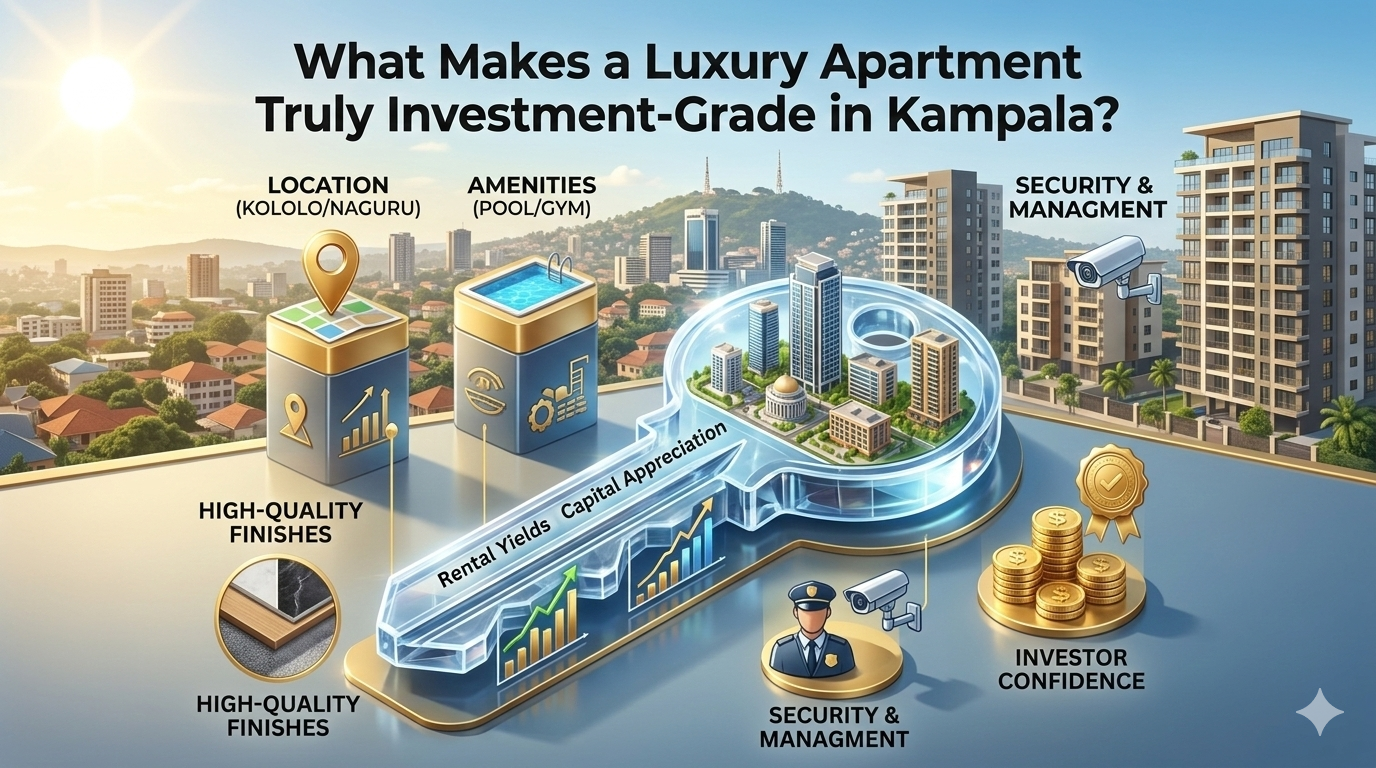

What Makes a Luxury Apartment Truly Investment-Grade in Kampala?
In Kampala, luxury and investment quality are no longer the same thing. A beautiful apartment may still struggle to hold rents, retain occupancy, or protect resale value if it is poorly planned, weakly managed, or priced beyond what the market can sustain. That distinction matters even more now. Uganda’s residential property market has remained firm, with UBOS reporting annual residential property inflation of 9.2 percent in Q2 FY2025/26, yet Knight Frank’s Kampala reviews show that parts of the apartment market, especially in prime areas, have faced rent pressure as supply has expanded and tenants have become more selective.
That is why the phrase investment-grade deserves to be used carefully. In real terms, an investment-grade luxury apartment is not simply one with premium finishes or a prestigious address. It is an apartment that can defend value through changing market cycles because it combines the right location, legal clarity, efficient design, credible construction quality, resilient tenant appeal, and a realistic path to resale or long-term income. In Kampala today, that standard is becoming far more important than image alone.
Location still matters, but not in the old superficial way
A prime address remains one of the strongest anchors of apartment value in Kampala, but buyers are becoming more analytical about what “prime” actually means. Knight Frank’s H1 2025 review found that premium apartments in locations such as Kololo, Naguru, and Nakasero continued to attract demand, particularly where they were modern, well-serviced, professionally managed, and close to essential amenities. At the same time, older units and less-serviced properties experienced longer vacancy periods. The lesson is clear: location on its own is not enough; location has to be matched with product quality and operational credibility.
This is where investment-grade thinking begins. A strong luxury apartment should sit in a neighborhood with enduring appeal to multiple buyer and tenant groups, not just one temporary segment. In Kampala, that usually means an area with status, security, infrastructure access, strong road connectivity, and proximity to diplomatic, business, hospitality, and lifestyle nodes. The more diverse the demand base, the more resilient the asset tends to be over time. That is one reason prime neighborhoods continue to matter even when market conditions become more selective.
The best luxury investments are designed for real use, not just visual appeal
An apartment becomes investment-grade when the layout works in daily life. In softer or more competitive rental markets, tenants and buyers quickly punish inefficient space. Oversized corridors, awkward room placement, poor natural lighting, and impractical kitchens may still look acceptable in brochures, but they weaken both rental performance and resale confidence. By contrast, layouts that maximize livable space, privacy, flow, and functionality are more likely to stay attractive across tenant types and buyer cycles. This is partly an investment judgment, but it follows directly from the market’s growing price sensitivity and selective demand.
RF Developers’ own Skyrise project is positioned around this logic. The project page emphasizes expansive layouts, functional interiors, golf-course views, and 2- and 3-bedroom configurations in Kololo, alongside amenities and a private setting. Those are the kinds of physical characteristics that matter because they support both end-user appeal and long-term marketability, especially in a premium neighborhood where buyers expect more than surface-level luxury.
Legal clarity is part of the investment case
A luxury apartment cannot be called investment-grade if ownership rights, approvals, or delivery obligations are unclear. In a market where buyers are increasingly careful, legal clarity is not a back-office matter; it is a value driver. RF Developers’ own quality and due-diligence content highlights the importance of verifying land title, developer registration, permits, approvals, stage inspections, occupation permitting, payment schedules, and contract terms before purchase. That kind of documentation is not just about compliance. It directly affects confidence, financing readiness, exit potential, and the ability of a buyer to sleep well after committing capital.
This is especially important in off-plan or in-progress developments. RF Developers markets Skyrise as an in-progress development with flexible payment plans and a reservation structure, which makes due diligence around milestones, approvals, and delivery standards especially relevant. In investment terms, transparency reduces execution risk. The easier a project is to verify, the stronger its case as an investment-grade asset.
Construction quality is not a luxury feature; it is a return protector
In premium apartments, weak build quality usually shows up later as a financial problem. Finishing failures, poor waterproofing, low-grade fittings, elevator downtime, plumbing defects, and inconsistent common-area execution all erode rentability and resale confidence. By contrast, stronger construction quality helps preserve reputation, reduce maintenance shocks, and support a development’s standing in the market long after launch marketing fades. That is why RF Developers places so much emphasis on quality craftsmanship, premium materials, and QA/QC practices from permit stage to occupation.
Knight Frank’s H1 2025 Kampala review reinforces why this matters commercially. Even as prime market performance softened, the segment remained more resilient where residences were high-quality, professionally managed, secure, and close to essential amenities. In other words, the market itself is rewarding execution quality, not just branding.
Amenities should strengthen tenant demand, not just decorate a brochure
Not every amenity adds investment value. Some are expensive to maintain but have little influence on occupancy or achievable rents. Investment-grade luxury is usually built around amenities that improve everyday usability and support a premium tenant profile: reliable security, backup systems, parking, lifts, fitness spaces, strong common areas, and a setting that feels private and well-kept. The best amenities are the ones tenants actually use and future buyers can clearly value.
RF Developers positions Skyrise with amenities such as a swimming pool, gym, clubhouse, landscaped features, secure and private living, and a premium location. Those are commercially relevant because they support the kind of upper-income and expatriate demand that has historically anchored prime Kampala residential performance. In a more selective market, useful amenities help a project compete on livability rather than discounting.
Payment structure and entry pricing also determine investment quality
A strong apartment can still become a weak investment if the entry price is wrong or the payment structure is too rigid. This matters even more in a market where asking prices and tenant expectations are not always moving together. Knight Frank noted in H1 2025 that the market slowdown reflected, in part, a widening gap between asking prices and buyer or tenant expectations. That makes disciplined pricing and a workable payment path central to investment quality.
RF Developers explicitly markets flexible payment plans, early investor opportunities, and staged buying access around Skyrise. From an investment perspective, that matters because capital efficiency changes the return profile. A buyer who can enter a quality project through a manageable structure may be better positioned than one forced into a high-friction purchase, even before rental or resale performance is considered.
Management and service quality are often the difference between luxury and durable value
One of the most underestimated parts of investment-grade real estate is what happens after handover. Apartments do not retain value by design alone. They retain value through ongoing management quality, disciplined maintenance, service-charge realism, and the ability of the owners’ ecosystem to preserve standards in common areas and building systems. In Kampala, where some prime stock is facing more competition, this becomes a major differentiator. The market is less forgiving of buildings that look strong at launch but deteriorate operationally over time. That conclusion is an inference, but it is strongly supported by the resilience Knight Frank observed in high-quality, professionally managed residences compared with less-serviced stock.
For serious investors, this means due diligence should include questions beyond the unit itself. Who will manage the building? What will service charges cover? How will lifts, backup systems, security, landscaping, and shared amenities be maintained? What governance or condominium structure supports the long-term condition of the asset? Those questions are central to whether a luxury apartment behaves like a lasting investment or simply an expensive purchase.
Exit potential is the final test
The real test of an investment-grade apartment is not only whether it can be bought, rented, or enjoyed now. It is whether someone else will still want it later. Resale depth depends on a combination of factors: address quality, building reputation, legal clarity, design relevance, management standards, and how well the asset compares with newer supply entering the market. In Kampala’s current environment, where supply growth has made buyers and tenants more selective, exit quality matters more than ever.
That is why truly investment-grade luxury tends to feel balanced. It is prestigious, but not vanity-led. It is attractive, but also efficient. It is premium, but still grounded in what the market can sustain. It is aspirational, yet verifiable. The projects most likely to hold long-term value are those that can satisfy both an emotional buyer and a rational investor at the same time.
What this means in Kampala right now
Kampala still offers real long-term apartment opportunity, but the bar is higher than it used to be. UBOS data show continued property-price momentum, yet Knight Frank’s market reviews make it clear that demand is increasingly selective and that some rent pressure exists in the prime apartment segment. In that environment, the apartments most likely to outperform are not simply the most expensive or the most heavily marketed. They are the ones that combine prime location, legal and delivery transparency, efficient layouts, strong amenities, quality construction, management readiness, and realistic pricing discipline.
For RF Developers, this is exactly where the conversation should sit. The company already positions itself around quality, innovation, sustainability, investment value, and prime Kampala development, while Skyrise is presented as a 72-unit luxury apartment scheme in Kololo with 2- and 3-bedroom formats, premium finishes, amenities, and flexible payment plans. In a market that is rewarding better product definition and stronger execution, those are the qualities that move a project closer to being genuinely investment-grade.
FAQ`s
What does investment-grade mean for a luxury apartment in Kampala?
It means the apartment is positioned to protect value over time through strong location, legal clarity, efficient design, build quality, resilient tenant appeal, and credible long-term management.
Are prime locations like Kololo still good for apartment investment?
Yes, but only when the development itself is competitive. Knight Frank found that high-quality, professionally managed residences in prime areas remained more resilient than older or less-serviced stock.
Why is legal due diligence important when buying a luxury apartment?
Because title verification, permits, approvals, contract review, and occupation readiness all affect risk, ownership security, and future resale confidence.
Do amenities really affect investment performance?
Yes, when they improve daily livability and support premium tenant demand. Security, lifts, fitness spaces, backup systems, parking, and well-maintained common areas can strengthen both occupancy and resale appeal.
Is flexible payment structure part of what makes an apartment investment-grade?
It can be. A sensible payment structure lowers entry friction and can improve the overall return profile, especially for buyers entering quality projects during construction.
What should buyers check before calling an apartment investment-grade?
They should assess the neighborhood, developer credibility, approvals, title structure, design efficiency, service-charge logic, amenities, management plan, and long-term resale potential.

RFdevelopers
Author
Ready to Experience Luxury Living?
Explore our exceptional developments and discover the perfect property for your lifestyle and investment goals.