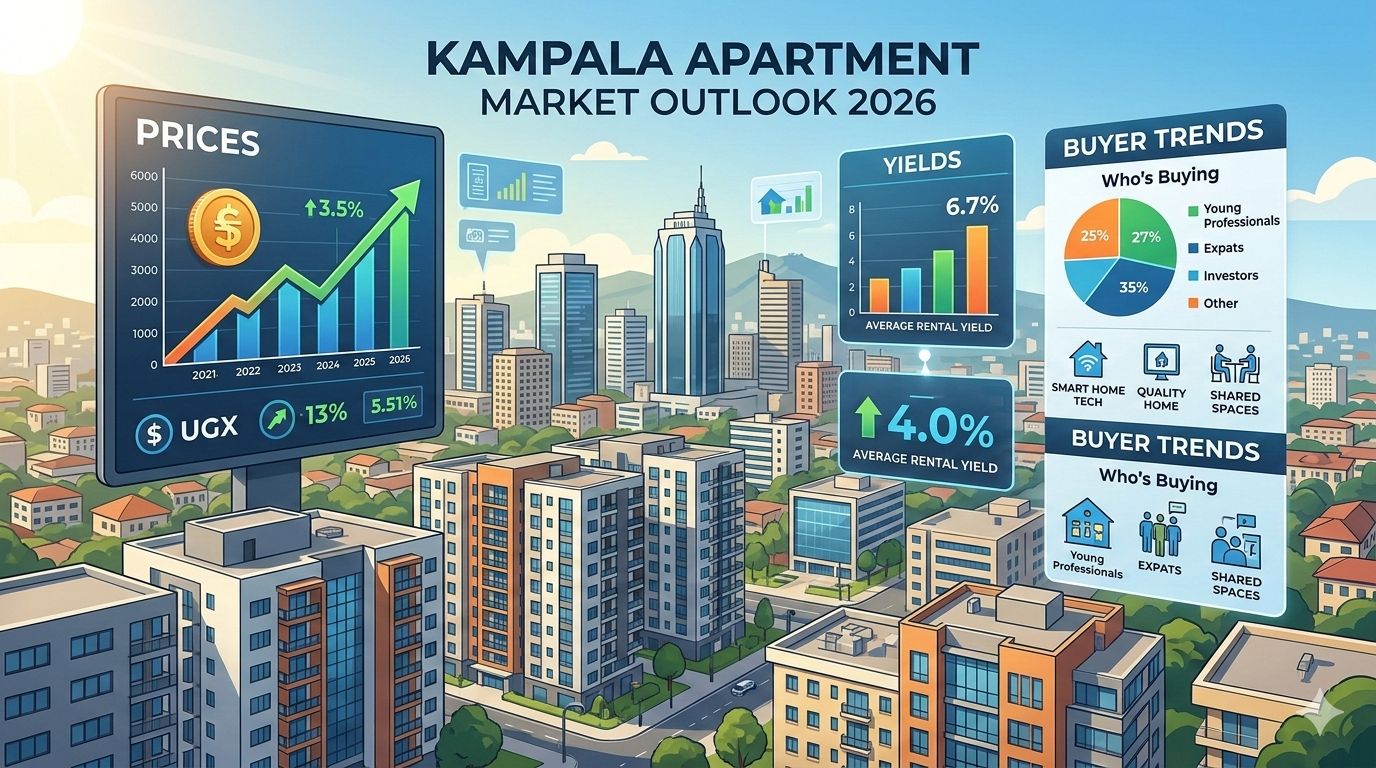

Kampala Apartment Market Outlook 2026: Prices, Yields, and Buyer Trends
Kampala enters 2026 with a property market that looks resilient at the macro level, but more selective on the ground. Uganda’s economy has remained on a strong growth path, with the IMF describing recent performance as broad-based and inflation as contained. At the same time, the Uganda Bureau of Statistics reported annual residential property inflation of 9.2 percent in Q2 FY2025/26, up from 4.7 percent in the previous quarter. That combination matters: the wider economy is supportive, but the apartment market is no longer rewarding every product equally.
What is emerging is not a simple “market up” story. It is a sorting market. Better-located, better-managed, and better-finished apartments are likely to defend value more effectively than older or less differentiated stock. For buyers and investors, that makes 2026 a year for discipline rather than assumption.
Prices are rising, but quality is becoming the real differentiator
The strongest immediate signal in the market is that residential prices are still moving upward. UBOS’s latest residential property index shows annual inflation at 9.2 percent for the year ending Q2 FY2025/26. That suggests continued value support across the sector.
But price strength alone does not tell the full story. Knight Frank’s H1 2025 Kampala market review found that prime residential occupancy had fallen to 80 percent and average rents for two-bedroom units had dropped by 7 percent, even while demand remained relatively resilient for high-quality, professionally managed residences in secure, gated communities. The market, in other words, is becoming more selective rather than uniformly weak or strong.
That distinction is especially important in prime neighborhoods. Prestige still matters, but it is no longer enough on its own. Buyers and tenants are paying closer attention to layout efficiency, amenity quality, security, management standards, and overall execution.
Yields are under pressure in parts of the market
For investors, the yield picture in 2026 is more nuanced than a simple headline percentage. If prices are rising while rents are softening in parts of the prime apartment market, some yield compression becomes inevitable, especially for undifferentiated units. That pressure is already visible in the data. In H1 2025, Knight Frank recorded a 7 percent decline in average two-bedroom rents in prime residential areas, alongside softer occupancy.
The softer trend appears to have continued into H2 2025. Knight Frank’s H2 2025 Kampala market review reported a 10 percent decrease in rental rates for two-bedroom units, a 9 percent decrease for three-bedroom units, and a 1 percent improvement in average occupancy. That suggests the market is still absorbing supply, but with more pricing sensitivity than before.
For investors, this means return quality now depends more heavily on choosing the right development, the right configuration, and the right location. In a more selective market, the best-performing assets are likely to be the ones that combine everyday livability with long-term investment logic.
Buyer behavior is shifting toward sharper value decisions
Kampala’s apartment market is also showing a more segmented buyer profile. Knight Frank’s H1 2025 review noted that secondary suburbs were seeing increased demand and rental growth, supported by affordability and changing tenant preferences. At the same time, two-bedroom and three-bedroom apartments remained among the preferred unit types.
By H2 2025, the market had become even more investment-rational. Knight Frank reported that sales demand was strongest in studios and one-bedroom formats, driven by investment-led purchases for the short-let market, while prime expatriate neighborhoods saw modest softening due to new supply and shifting tenant demographics.
That does not mean larger premium apartments have lost relevance. It means buyers are becoming more precise about what they are purchasing and why. Some are pursuing shorter-stay or income-led strategies. Others are still choosing prime, high-spec apartments for family living, wealth preservation, status, and location quality. The winning developments in 2026 will be the ones that can clearly justify their price.
Why the macro backdrop still supports the market
Despite segment-level pressure, the broader context remains constructive. The IMF said Uganda’s post-pandemic performance has been robust, with broad-based growth, contained inflation, and an improving external position. In late 2025, IMF staff also said the economy grew by 6.3 percent in FY2024/25 and that inflation remained below the 5 percent medium-term target.
That stability matters for real estate. It supports buyer confidence, helps preserve medium-term planning, and reinforces the case for property as a long-horizon asset. What it does not do is eliminate the need for product discipline. In 2026, a stable macro backdrop may support the market overall, but individual developments will still need to earn demand through quality, trust, and usability.
What this means for 2026 apartment buyers
For owner-occupiers, 2026 is a year to prioritize quality over hype. The strongest apartments are likely to be those in credible locations with solid legal structure, strong management potential, good design, and lifestyle practicality. A buyer should not only ask whether the apartment looks attractive today, but whether it will remain desirable three to five years from now.
For investors, the key question is no longer simply whether Kampala apartments are worth buying. It is which apartments are most likely to protect occupancy, attract quality tenants, and hold value as the market becomes more selective. That places more weight on execution, payment structure, amenities, service quality, and neighborhood strength.
FAQ`s
1) Is Kampala’s apartment market expected to grow in 2026?
Kampala’s apartment market enters 2026 with a supportive economic backdrop and rising residential property prices. UBOS reported annual residential property inflation of 9.2 percent in Q2 FY2025/26, while the IMF described Uganda’s recent growth as broad-based with contained inflation.
2) Are apartment prices in Kampala going up?
Broad residential property prices have been rising, based on UBOS’s latest RPPI release. However, pricing power is likely to be strongest in well-located, well-finished, and professionally managed developments rather than across all apartment stock.
3) Are rental yields in Kampala under pressure?
In parts of the prime apartment market, yes. Knight Frank reported a 7 percent drop in average two-bedroom rents in H1 2025, and the H2 2025 review indicated further declines in two-bedroom and three-bedroom rental rates, even as occupancy improved slightly.
4) Which apartment buyers are active in Kampala right now?
The market is being shaped by multiple buyer groups, including investors targeting income opportunities, affluent Ugandans, diaspora buyers, and premium owner-occupiers. Knight Frank’s reporting shows shifting tenant and buyer demographics, with stronger interest in formats and locations that align with current value expectations.
5) Are prime areas like Kololo still attractive in 2026?
Yes, but buyers are more selective than before. Prime areas still benefit from status, convenience, and established demand, yet the stronger-performing apartments are likely to be the ones with superior quality, management, security, and overall execution.
6) What should investors focus on before buying an apartment in Kampala?
Investors should focus on legal clarity, location strength, rental resilience, build quality, service-charge realities, and how well the development is positioned to retain tenant demand in a more selective market. That is increasingly more important than relying on location prestige alone.

RFdevelopers
Author
Ready to Experience Luxury Living?
Explore our exceptional developments and discover the perfect property for your lifestyle and investment goals.